The Little Grass Doll
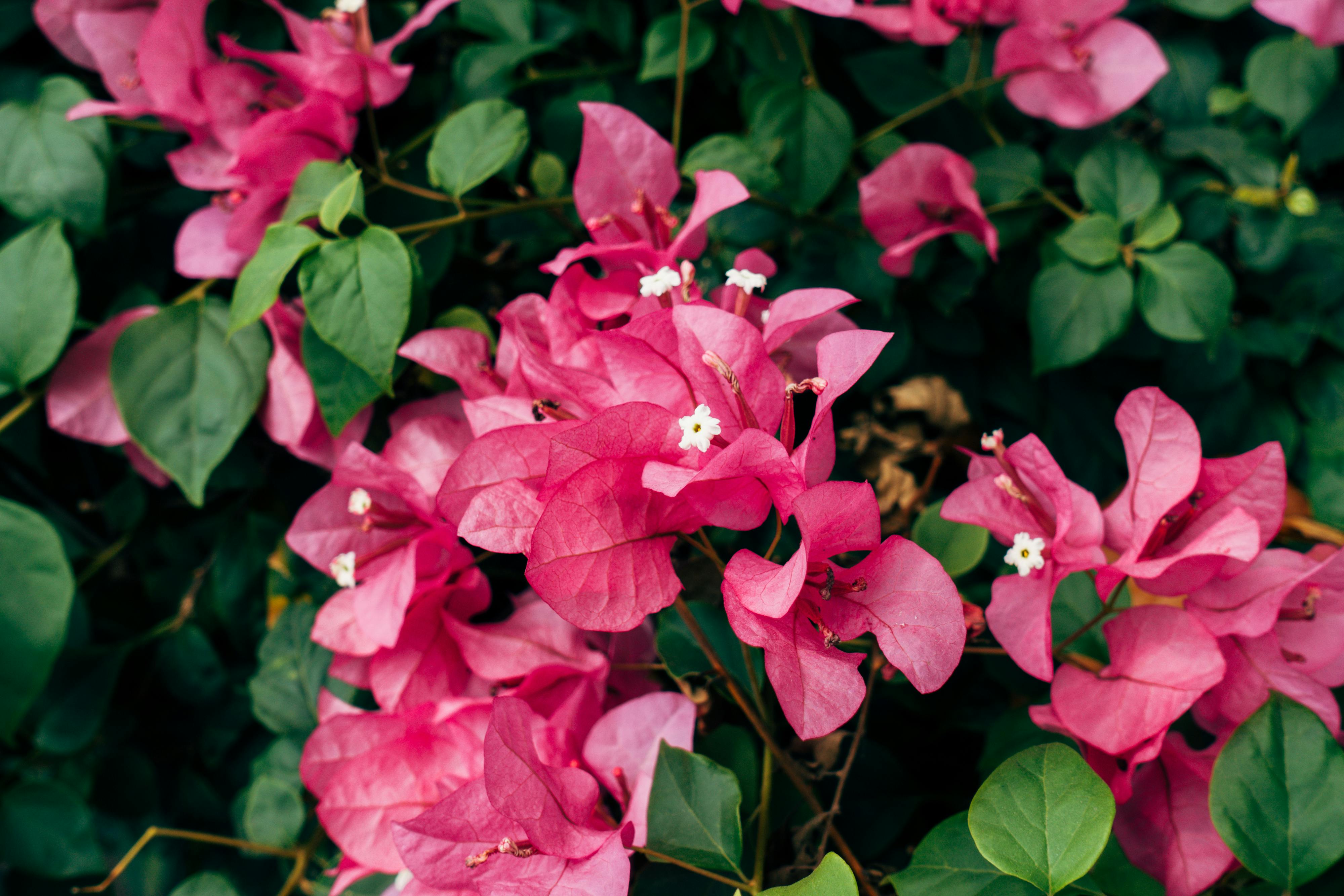
The summers of my childhood passed amidst houses crouched in the hills and deserted streets.
Cicadas in the bare almond trees.
The murmur of a highway in the distance.
Paula and I played in the valleys. On any given afternoon you could find our bikes lying on the road and our footprints on a path that led to an ancient carob tree. Among its branches we had our hideout, a few nailed planks that creaked more under our weight with every passing year.
If you followed the dry streambed upstream, to where you could no longer see the houses or hear the highway, there was a thicket of bougainvillea, and within it, a passage. We had to go on all fours to get through, and the thorns scratched our forearms and calves.
At the heart of the hedges a vault opened where the sun fell violet through the flowers. And there lived our secret friends.
We never saw them, but we could feel their presence, as if they watched us from among the foliage. They seemed to accept us. Sometimes we left them gifts: a packet of puffed rice, a wooden spinning top, a little gold bracelet. And when we came back, they had accepted the trade. On the perpetually damp ground, a little doll braided from grass, a resin stone with a caterpillar sealed inside, a garland of flowers.
Neither Paula nor I told anyone. No one would have believed us.
I don’t remember how long it lasted. A couple of years, maybe. Of summers, which was how we measured time. I don’t remember how we found them either, but I do remember the last time I was there.
One morning I went to look for Paula, and the brute she had for a father sent me away without explanation. I spent the day pedalling through the empty streets, lost, ringing Paula’s doorbell from time to time without getting an answer. That night, back home, my parents told me over dinner that Paula had disappeared, that her parents had reported it, that nobody knew anything.
My memory of the days that followed is a puzzle missing half its pieces. I remember an inspector who smelled of coffee and asked useless questions. I remember looking at my bicycle lying alone in the street and feeling dizzy. Ringing Paula’s doorbell and her screaming at me to go away. I remember crying in our hideout in the carob tree with only the cicadas for company. Paula was never coming back, and the certainty smothered me.
So I did the one thing I hadn’t done yet. I followed the streambed, I pushed through the passage in the bougainvillea and I begged whoever lived there to bring Paula back. I cried and felt ridiculous, but I also knew I was being watched. Among the flowers and the thorns, in that violet light, there were those who listened.
Days and nights passed and I felt the world forgetting Paula, felt the summer dying into September, into a new school year that was already looming on the horizon, and that I was expected to move on.
Then, one night, there was a tapping on my shutter that pulled me from a restless sleep. When I lifted it, on the sill sat a little doll braided from grass. The moment I held it in my hands I knew what it meant, and still in my pyjamas I went out into the street, got on my bicycle and, breathing in the sweet scent of jasmine and honeysuckle, pedalled to our hideout, ran up the streambed, tore my hands and face on the bougainvillea thorns.
And there she was, lying beneath the vault of flowers, in the dark, her snow-white skin covered in dew, her eyes closed and, on her chest, a little grass doll. I shook her frantically, fearing what the paleness of her skin could mean, but Paula opened her eyes and looked around, possessed by a strange calm. I called her name, I took her ice-cold hands, and she simply looked at me. And when she did, fear took hold of me. I pulled away from her, sensing that I didn’t recognise her, that this couldn’t be Paula. And yet, wasn’t that her face, her hair, her thread bracelets and her worn-out trainers? Her voice, flat and emotionless, asking me to take her home?
We left that place for the last time and I walked Paula home. She walked in silence, and when I dared to ask her questions she did not answer. I remember her father’s face in the lit doorway. His expression of horror and relief at once. The same expression he had when, a week later, once the murmur of police and reporters had finally faded, I watched them leave in a car packed with suitcases and boxes. Him, ashen behind the wheel. Paula, sitting in the back, as pale as she had been that night, her eyes fixed on me until the road carried her far from the estate, far from my life. Paula would not return to either place.
I did go back, years later, tormented by the memories. The hideout was still there, the planks rotted and the carob tree surrounded by terraced houses. I followed the streambed, but no matter how far I walked, no matter how far my adult legs carried me, there was no trace of the bougainvillea. But on some rocks, as if waiting for me, rested a little doll braided from grass.